Calls and Puts, Explained Simply
A FINZ guide · Updated 9 November 2026 · About an 8 minute read
Options are the part of the market people find most confusing, and the part where a little understanding changes the most. This guide explains what a call and a put are, what you actually pay, how each one makes or loses money, and how options work inside FINZ. The examples use a made-up stock called FISHY and round numbers, so the maths stays easy.
FINZ is a game for learning. Nothing here is financial advice, and FISHY is not a real company. Options are risky in real life, and FINZ is a place to see how they behave with nothing at stake.
What an option is
An option is a contract about a stock. It gives you the right, but not the obligation, to buy or sell 100 shares of that stock at a fixed price, called the strike, up to a fixed date, called the expiration. You pay for that right up front, and the price you pay is called the premium.
There are two kinds:
- A call is the right to buy at the strike. Calls gain value when the stock goes up.
- A put is the right to sell at the strike. Puts gain value when the stock goes down.
That is the whole idea. Everything else is detail about how much that right is worth, and when.
What you actually pay
Option prices are quoted per share, but one contract covers 100 shares. So a call listed at $2.00 costs $200 for one contract, and three contracts cost $600. This catches out almost everyone the first time, which is why FINZ shows both: the price per share, and, in yellow, what the number of contracts you have typed in will cost.
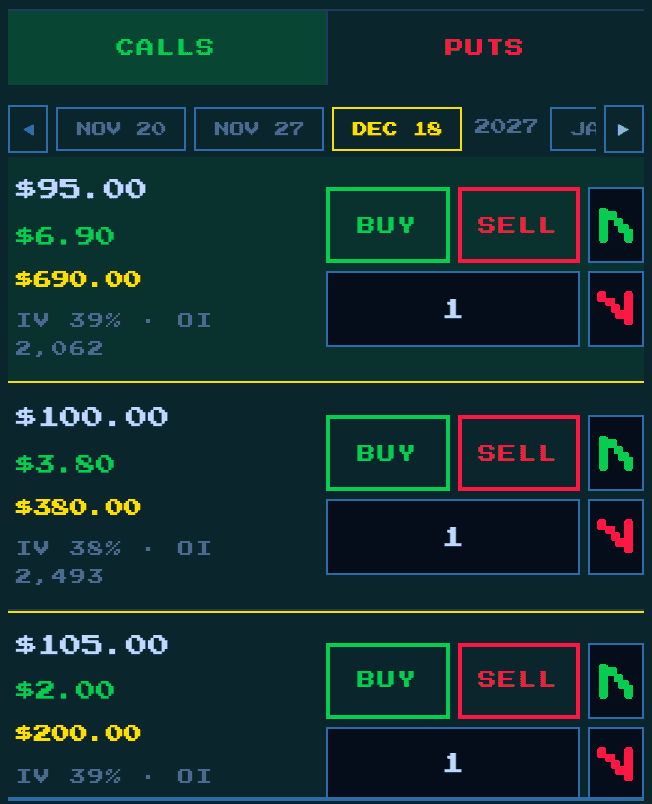
The two small figures under each row are worth knowing. IV, implied volatility, is how big a move the market expects from the stock: higher IV makes options more expensive. OI, open interest, is how many contracts at that strike are currently held across the whole market, a rough sign of how popular it is.
A call, step by step
FISHY trades at $100. You think it is going up, so you buy one $105 call expiring in about a month, at $2.00 a share. One contract, so you pay $200. Here is what it is worth on the expiration date:
- FISHY at $115. Your call lets you buy at $105 shares that are worth $115. That is $10 a share, or $1,000 for the contract. You paid $200, so you made $800: four times your money, on a stock that rose 15%.
- FISHY at $106. The call is worth $1 a share, $100 in all. You lost $100, even though the stock went up.
- FISHY at $105 or lower. The right to buy at $105 is worth nothing. The contract expires worthless and you lose the whole $200.
That last case is what makes options different from shares. Someone who spent $200 on two FISHY shares would still own about $200 of stock if the price went nowhere. An option buyer can lose everything they paid without the stock falling at all, simply because it did not rise far enough, soon enough.
The break-even for a call held to expiration is the strike plus what you paid per share. For this one, $105 plus $2.00 is $107: FISHY has to be above that for the trade to make money.
A put, step by step
Now say you think FISHY is going down. You buy one $95 put at $1.50 a share, so $150 for the contract.
- FISHY falls to $85. Your put lets you sell at $95 shares that are worth $85: $10 a share, or $1,000 for the contract. Your profit is $850.
- FISHY stays at $95 or higher. The right to sell at $95 is worth nothing, and you lose the $150.
The break-even for a put is the strike minus what you paid: $95 minus $1.50 is $93.50.
In, at and out of the money
- In the money means the option would be worth something if it expired right now: a call with its strike below the stock's price, or a put with its strike above it. FINZ shades these rows in the list.
- At the money means the strike is about where the stock is. FINZ opens the list on the strike nearest the current price, so that is the first row you see.
- Out of the money means it would be worth nothing if it expired now. These options are the cheapest, because the stock still has to move for them to pay anything.
Why the price moves before expiration
Most option trades never get to the expiration date. People buy a contract, then sell it again once its price has moved. That price is made of two parts:
- Intrinsic value: what the option would be worth if it expired now. A $105 call with FISHY at $108 has $3.00 of intrinsic value.
- Time value: everything on top of that, which is the market's price for the chance that the option becomes worth more before it expires. More time left, and a jumpier stock, both mean more time value.
Time value shrinks as the expiration date gets closer, slowly at first and then quickly in the last few weeks. This is called time decay. It means an option can lose value on a day the stock does not move at all, and it is why selling a winning option before it expires can get you more than waiting: you also collect the time value that is left.
Example
Two weeks after you bought your $105 call, FISHY is at $108. The call has $3.00 of intrinsic value, and with two weeks still to go it might trade at about $4.00, so selling would get you $400 for the $200 you paid. If FISHY is still at $108 on the expiration date itself, the time value is gone and the same contract is worth $300.
How options work in FINZ
Finding them
Search for a stock or ETF, tap its card to open it, then tap CALLS or PUTS. A row of expiration dates appears above the list. Pick one, and the strikes for that date open on the one nearest the stock's price. Every strike and date the real market lists is there, from contracts that expire this week to ones a year or more away on the busiest stocks. Crypto has no options in FINZ.
Prices
FINZ uses the real options market. A contract's price is normally the midpoint between the best price anyone is offering to buy at (the bid) and to sell at (the ask). If a live price cannot be reached, FINZ estimates one with a standard pricing formula so the game keeps working.
Buying and selling
Type how many contracts you want, or use the arrows, and press BUY. You need enough cash for the whole cost. You can SELL contracts you own at any time, but FINZ does not let you sell options you have not bought first.
Market hours
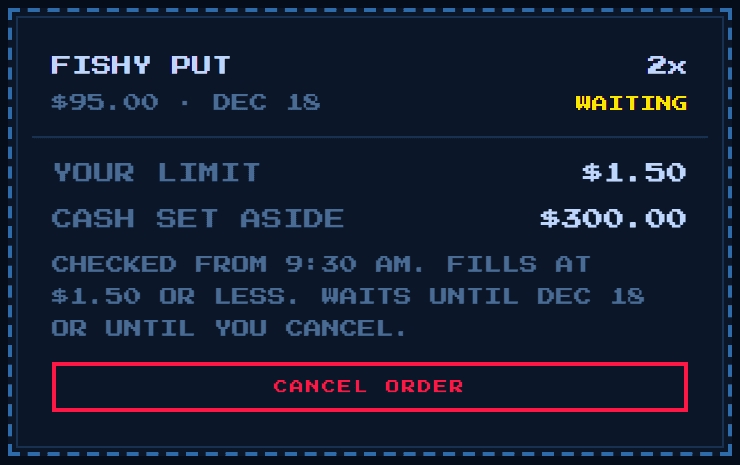
Options trade from 9:30am to 4:00pm New York time on weekdays. Outside those hours their prices stop moving, even though the stock can keep trading, so buying at the frozen price would not be fair. Instead, a BUY after the close places an order. FINZ sets the cash aside, and from the next opening bell it buys the contract as soon as its price is at or below the price you saw. If it fills cheaper, you keep the difference. The order waits until it fills, you cancel it (and get all the cash back), or the contract expires. Selling still happens straight away, at the last price from the close.
In your portfolio
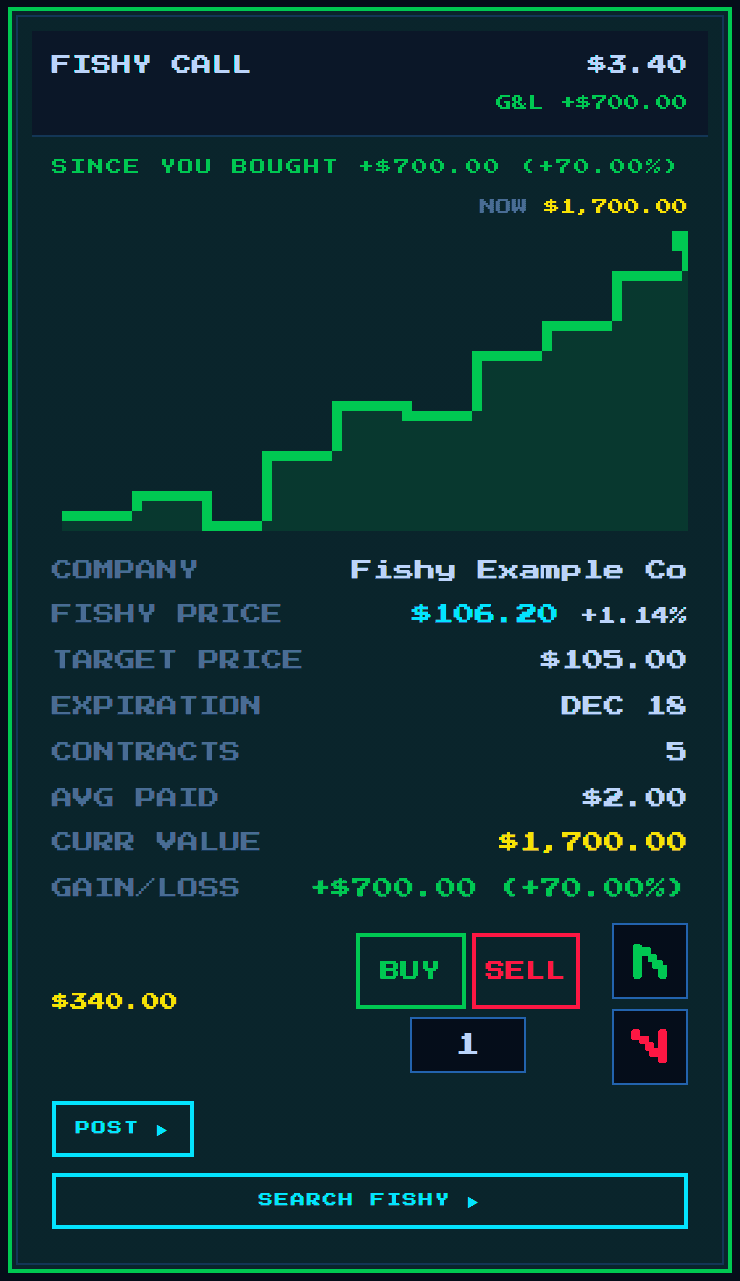
Each option you own gets its own card on the OPTIONS side of your portfolio. It shows the stock's price, the strike (as TARGET PRICE), the expiration, how many contracts you hold, the average price you paid, what they are worth now, and your gain or loss. Its chart shows what your contracts have been worth since you bought them.
Expiration
On its last day a contract's card says EXPIRES TODAY and stays at the top of your options. That evening, after the market has closed, FINZ settles anything you still hold. An option in the money pays you what it is worth in cash: for a call, how far the stock is above the strike, times 100 for each contract, and for a put, how far it is below. An option out of the money simply disappears. FINZ never turns options into shares, so there is nothing else to manage.
Seeing what others do
TRENDING OPTIONS, on the SEARCH page, shows the stocks whose calls and puts FINZ players have bought the most this session, with a chart of which strikes were popular. It is a fun way to see what everyone else is betting on, and a reminder that a crowd can be wrong.
Things to remember
- You can lose everything you paid for an option, even if the stock barely moves against you.
- A cheap option is cheap for a reason: it needs a bigger move to pay off.
- Time works against an option buyer every single day.
- Huge percentage wins are possible, which is exactly why huge percentage losses are common.
- In real life, brokers only let adults trade options, usually after an approval step. Learning how they behave first, with fake money, is the sensible order to do it in.
Words to know
- Call
- The right to buy 100 shares at the strike, up to the expiration.
- Put
- The right to sell 100 shares at the strike, up to the expiration.
- Strike
- The fixed price in the contract. FINZ shows it as TARGET PRICE on your card.
- Expiration
- The last day the contract exists.
- Premium
- The price of the option, quoted per share. Multiply by 100 for one contract.
- Contract
- One option, covering 100 shares.
- Intrinsic value
- What the option would be worth if it expired right now.
- Time value
- The rest of the price: what the market pays for the chance of more.
- Time decay
- Time value shrinking as the expiration date gets closer.
- Break-even
- Where the stock must be at expiration for the trade to make money: strike plus premium for a call, strike minus premium for a put.
- IV (implied volatility)
- How big a move the market expects. Higher IV means pricier options.
- OI (open interest)
- How many contracts at a strike are currently held across the market.
- Bid and ask
- The best prices on offer to buy and to sell. FINZ prices at the midpoint between them.
Try it in FINZ
The OPTIONS walkthrough in FINZ shows you each of these steps on a real stock, and you can buy your first contract with the game's $10,000. You will need a free account to trade.
TRY IT IN FINZ ▶